Selecting a diesel dispenser by maximum litres per minute alone can produce an oversized or poorly matched system. The correct fuel dispenser flow rate depends on peak fuel demand, typical fill size, power and pump architecture, hose arrangement, suction conditions and duty cycle. This guide uses current Eastman specifications to compare 40, 80 and 90 LPM classes for industrial refuelling.
Eastman currently lists EMDU-BT-20 at 1-40 LPM, EMDU-PTO-25 at 1-80 LPM and MD25/NP at 1-90 LPM. All three pages list ±0.1% accuracy, but the equipment does not share the same pump or installation design. That is why fuel dispenser flow rate should be treated as one engineering variable rather than a standalone buying number.
What Is Fuel Dispenser Flow Rate?
Fuel dispenser flow rate is the volume of liquid transferred per unit of time, commonly expressed in litres per minute (LPM). A higher LPM can shorten a fill only when the pump, meter, tank outlet, hose, nozzle and receiving equipment can support that rate. For buyers, the useful question is not “What is the highest dispenser rate?” but “What rate meets our peak demand without unnecessary complexity?”
Wikipedia – Flow measurement provides the general engineering context for volumetric flow measurement.
Fuel Dispenser Flow Rate: 40 LPM vs 80 LPM vs 90 LPM
The comparison below uses values currently published by Eastman. Treat them as shortlisting data and confirm the final configuration for the site before procurement.
Eastman Example | Published Range | Power / Pump Context | Accuracy | Selection Logic |
EMDU-BT-20 | 1-40 LPM | 12V/24V DC; dual-vane pump | ±0.1% | Compact / moderate throughput |
EMDU-PTO-25 | 1-80 LPM | Truck PTO; rotary gear pump | ±0.1% | Dedicated bowser / higher throughput |
MD25/NP | 1-90 LPM | 12V DC supply; optional PTO pump listed | ±0.1% | High-throughput; verify final setup |
Theoretical fill times assume the published LPM is sustained. Actual site flow can vary with suction, hose, fittings, fluid and pump configuration. |
40 LPM Fuel Dispenser Flow Rate: Compact Mobile Refuelling

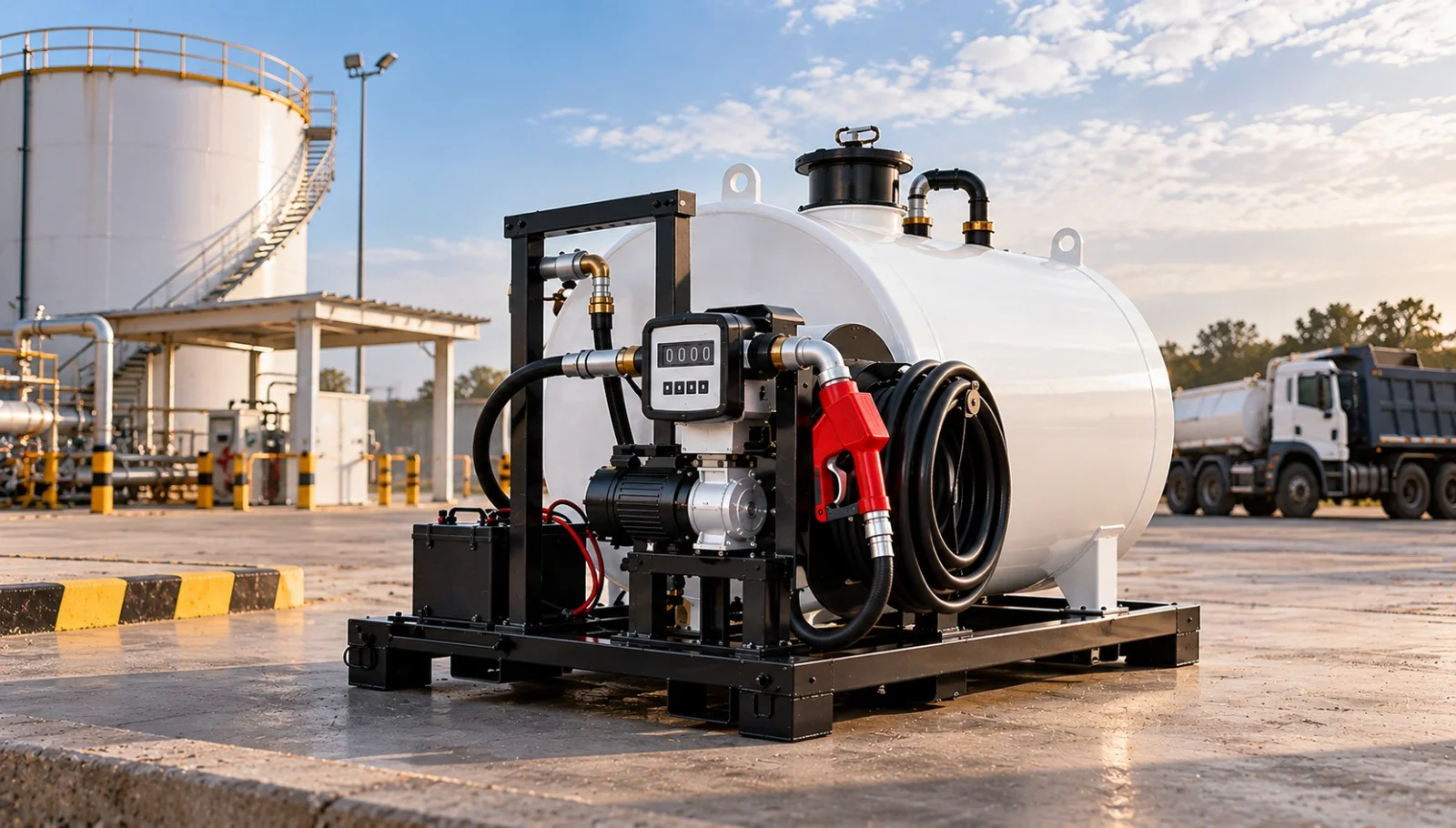
Eastman’s EMDU-BT-20 is listed at 1-40 LPM with a 12V/24V DC electrical supply, dual-vane transfer pump, 10 m x 3/4-inch hose, positive displacement meter, preset controls and micro-printer. A 40 LPM fuel dispenser flow rate can suit generator service, smaller fleets, agricultural equipment and mobile delivery where compact installation matters more than maximum throughput.
At a theoretical 40 LPM, 100 litres takes 2.5 minutes. Real filling time can be longer because suction head, filters, hose losses, fluid condition and operating practice can reduce actual output. Use the calculation for planning, not as a guaranteed site result.
80 LPM Fuel Dispenser Flow Rate: Higher-Throughput Truck Operations
Eastman’s EMDU-BT-20 is listed at 1-40 LPM with a 12V/24V DC electrical supply, dual-vane transfer pump, 10 m x 3/4-inch hose, positive displacement meter, preset controls and micro-printer. A 40 LPM fuel dispenser flow rate can suit generator service, smaller fleets, agricultural equipment and mobile delivery where compact installation matters more than maximum throughput.
At a theoretical 40 LPM, 100 litres takes 2.5 minutes. Real filling time can be longer because suction head, filters, hose losses, fluid condition and operating practice can reduce actual output. Use the calculation for planning, not as a guaranteed site result.
90 LPM Fuel Dispenser Flow Rate: Highest Listed Range in This Comparison
Eastman’s MD25/NP page lists 1-90 LPM, ±0.1% accuracy, 1-inch BSP inlet/outlet, positive displacement metering, preset functions, ticket printing and communication interfaces. It also lists a 12V DC supply and optional PTO-operated gear-pump accessories.
A 90 LPM fuel dispenser flow rate is relevant when fast turnaround is genuinely valuable and the configured pump, suction and hose system can support it. The theoretical time for 100 litres is about 1.11 minutes, only around eight seconds faster than 80 LPM, so calculate whether that difference matters at your daily volume.
Why Higher Fuel Dispenser Flow Rate Is Not Automatically Better
A higher fuel dispenser flow rate can save time, but it can also add unnecessary installation requirements if the site performs only a few small fills. A busy fleet may benefit greatly from faster dispensing; a low-volume generator site may not. The best dispensing rate balances transfer time with the capabilities of the vehicle, tank, pump, meter and hose.
7 Factors That Decide the Right Fuel Dispenser Flow Rate
Use these checks before selecting a system. They convert the published LPM figure from a headline number into a practical specification.

1. Litres During the Busiest Hour
Peak demand matters more than daily total. If many vehicles need fuel during one dispatch window, the required dispensing capacity can be much higher than at a site that spreads the same litres across the whole day.
2. Typical Fill Quantity
Large equipment tanks benefit more from a higher transfer rate. For small top-ups, positioning, preset entry and receipt handling can take longer than the pumping difference between 80 and 90 LPM.
3. Power and Pump Architecture
The Eastman 40 LPM example uses DC electrical pumping, while the 80 LPM example uses PTO. The 90 LPM MD25/NP page lists optional PTO pump accessories. Match the target fuel dispenser flow rate to the power system the vehicle and duty cycle can support.
4. Hose Length and Diameter
Eastman lists a 3/4-inch hose on the 40 LPM model and a 1-inch hose on the 80 LPM model. Restrictive hoses, fittings and elevation can reduce delivered flow, so fuel dispenser flow rate must be evaluated across the full delivery path.
5. Meter Type and Accuracy
The compared Eastman units use positive displacement metering and list ±0.1% accuracy. A suitable fuel dispenser flow rate should remain within the meter’s specified operating range, with calibration and maintenance handled as required for the actual application.
Wikipedia – Positive displacement meter explains the fixed-volume measurement principle used by this meter family.
6. Transaction and Monitoring Needs
Preset quantity, printed receipts, totalisers and communication options can matter as much as pumping speed. A faster unit that cannot provide the required issue records may not solve the business problem.
7. Real Site Conditions
Tank level, suction lift, filters, fluid viscosity, temperature and maintenance condition can affect transfer performance. Published fuel dispenser flow rate values are specification ranges; verify final performance after installation and commissioning.
Simple Throughput Planning for 40, 80 and 90 LPM
At theoretical rated flow, 200 litres takes about 5 minutes at 40 LPM, 2.5 minutes at 80 LPM and 2.22 minutes at 90 LPM. A realistic fuel dispenser flow rate plan should also allow for positioning, nozzle handling, preset entry, printing and operator checks.
Which Eastman Fuel Dispenser Flow Rate Should You Shortlist?
Shortlist 40 LPM when moderate throughput and compact electrical pumping are priorities. Consider 80 LPM for a PTO bowser needing higher throughput. Consider the 90 LPM MD25/NP range when the operation genuinely needs the highest listed flow and the final hydraulic setup supports it. The correct fuel dispenser flow rate follows the job requirement, not the biggest number.
Frequently Asked Questions
No. The correct fuel dispenser flow rate depends on throughput, power system, hose layout and duty cycle. A smaller unit can be the better fit when fast transfer is not operationally important.
The theoretical time is 2.5 minutes. Actual time can be longer because the rated output may not be achieved continuously under every installation condition.
Pump capacity describes the pump’s potential output, while dispenser flow range is the published operating range of the metering/dispensing system. They should not be treated as identical values.
Not necessarily when equipment operates within its specified range and is correctly calibrated. Eastman lists ±0.1% accuracy for the three models discussed here.
Conclusion: Size Fuel Dispenser Flow Rate Around Peak Demand
The best fuel dispenser flow rate is the one that meets peak demand without unnecessary complexity. Eastman’s current reference points are 1-40 LPM for EMDU-BT-20, 1-80 LPM for EMDU-PTO-25 and 1-90 LPM for MD25/NP.
Calculate litres per hour, typical fill size and desired turnaround first, then check vehicle power, hose routing, tank outlet, meter range and reporting needs. That process produces a more reliable fuel dispenser flow rate specification than selecting the highest LPM figure alone.