Choosing a mobile fuel dispenser is not simply a matter of selecting the highest litres-per-minute figure. The right system depends on fuel volume, vehicle platform, duty cycle, hose layout, power source and the level of transaction control required. This 12V DC vs PTO Fuel Dispenser guide compares two current Eastman configurations so industrial buyers can make a practical, specification-led decision.
Eastman’s EMDU-BT-20 digital mobile unit is listed at 1-40 LPM and uses a 12V/24V DC electrical supply, while the EMDU-PTO-25 is listed at 1-80 LPM and uses truck power take-off to drive an internal rotary gear pump. Both pages list ±0.1% accuracy, preset operation and a micro-printer. The key difference in a 12V DC vs PTO Fuel Dispenser decision is therefore not only speed; it is how the whole dispensing system fits the vehicle and the job.
What Does 12V DC vs PTO Fuel Dispenser Mean?
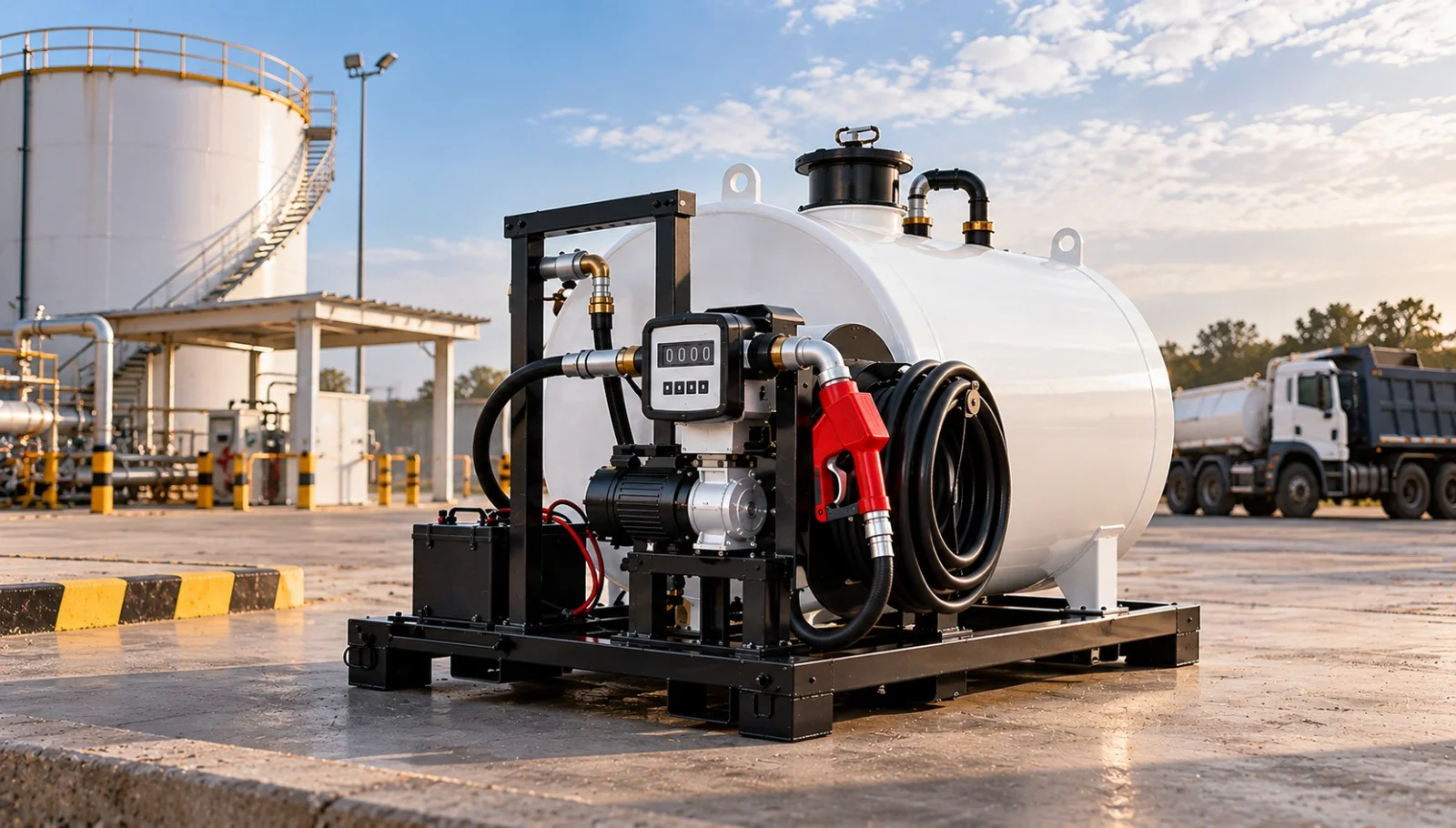
A 12V DC vs PTO Fuel Dispenser comparison begins with the power source. The DC model uses battery or vehicle electrical power for the transfer pump and controller. Eastman describes EMDU-BT-20 as a compact mobile unit that can be mounted with an IBC or small demountable tank on a van, pickup or drop-side truck.
A PTO dispenser takes mechanical power from the truck engine through a power take-off. Eastman’s PTO model uses the truck auxiliary gearbox to drive an internal rotary gear pump. Its page mentions a 100 LPM pump in the system description but separately lists the dispenser flow range as 1-80 LPM. A correct 12V DC vs PTO Fuel Dispenser comparison keeps pump rating and dispenser flow range separate.
Wikipedia – Power take-off explains the general PTO principle.
12V DC vs PTO Fuel Dispenser: Verified Specification Comparison
The figures below are taken from Eastman’s current model pages. They are useful for shortlisting, but final performance can vary with tank position, suction, hose routing, fluid condition and installation.
Specification | EMDU-BT-20 DC | EMDU-PTO-25 PTO |
Published flow range | 1-40 LPM | 1-80 LPM |
Power / pump | 12V/24V DC; dual-vane pump | Truck PTO; internal rotary gear pump |
Published accuracy | ±0.1% | ±0.1% |
Hose | 10 m x 3/4 in | 10 m x 1 in |
Max pressure | 50 PSI | 50 PSI |
Max temperature | 55°C | 55°C |
Digital functions | Preset + micro-printer | Preset + micro-printer |
Use these figures for model comparison only. Confirm final installation performance and approval documents for the exact supplied configuration. |

When a 12V DC Fuel Dispenser Is the Better Fit
In a 12V DC vs PTO Fuel Dispenser project, the DC option is usually attractive when compact installation, moderate throughput and easy vehicle integration matter most. EMDU-BT-20 is listed with a 1-40 LPM range, 10 m x 3/4-inch self-retractable hose, positive displacement meter, preset controls and ticket printer.
This profile can suit generator service, smaller fleet operations, construction support and mobile delivery where 40 LPM meets the required turnaround time. A 12V DC vs PTO Fuel Dispenser review should still check battery capacity, charging arrangement, cable sizing and duty cycle for the final installation. That keeps the 12V DC vs PTO Fuel Dispenser choice aligned with real operating hours.
When a PTO-Operated Fuel Dispenser Makes More Sense
The PTO side of a 12V DC vs PTO Fuel Dispenser comparison becomes stronger when the dispenser is part of a dedicated fuel truck or bowser and higher throughput is required. EMDU-PTO-25 is listed at 1-80 LPM with a 1-inch x 10 m hose and an internal rotary gear pump.
PTO is not automatically the better option. The truck must have a suitable PTO arrangement, and installation compatibility should be checked with the vehicle manufacturer or a qualified installer. Choose PTO when the operational benefit of higher transfer capacity justifies that integration. This makes the 12V DC vs PTO Fuel Dispenser selection a vehicle-and-duty-cycle decision.
Wikipedia – Fuel dispenser describes the core function of fuel-dispensing equipment.
7 Smart Checks Before Choosing 12V DC vs PTO Fuel Dispenser
Use these checks to turn the 12V DC vs PTO Fuel Dispenser question into a site-specific buying decision rather than a simple 40-versus-80 LPM comparison.
1. Peak Fuel Demand
Calculate litres required during the busiest hour. A 40 LPM unit may be enough for moderate work, while a higher-flow PTO unit can reduce queues when several machines must be refuelled quickly. Base the 12V DC vs PTO Fuel Dispenser choice on peak demand, not only daily totals.
2. Vehicle and Tank Platform
A pickup or compact demountable tank can favour DC. A dedicated bowser already engineered for PTO equipment can favour PTO. For every 12V DC vs PTO Fuel Dispenser installation, confirm tank outlet, mounting space, suction path and maintenance access.
3. Required Flow Rate
Do not buy the biggest number automatically. Define the desired fill time for typical equipment, then choose the required range. A sound 12V DC vs PTO Fuel Dispenser decision starts with the job cycle and works backward to the dispenser.
4. Hose Diameter and Delivery Distance
Eastman lists a 3/4-inch hose on the 40 LPM DC model and a 1-inch hose on the 80 LPM PTO model. Hose length, fittings and elevation affect pressure loss, so a 12V DC vs PTO Fuel Dispenser project should be reviewed as a complete hydraulic system.
5. Preset and Transaction Records
Both compared digital units list preset-by-volume or price and instant printing. If your workflow needs vehicle IDs, software integration or special reports, confirm the exact controller before ordering. Power source alone does not decide record quality in a 12V DC vs PTO Fuel Dispenser setup.
6. Meter Accuracy and Calibration
Both Eastman pages list ±0.1% accuracy and positive displacement metering. Ask how calibration is carried out, what controls or seals are supplied and what maintenance is recommended. These details are as important as flow rate in a 12V DC vs PTO Fuel Dispenser purchase.
7. Approval Status of the Exact Model
Eastman’s compared model pages state Legal Metrology/Weights & Measures approval for the relevant metering arrangements. Do not assume one approval statement covers every custom build. A responsible 12V DC vs PTO Fuel Dispenser procurement process verifies the documents applicable to the exact supplied configuration.
12V DC vs PTO Fuel Dispenser for Common Industrial Applications
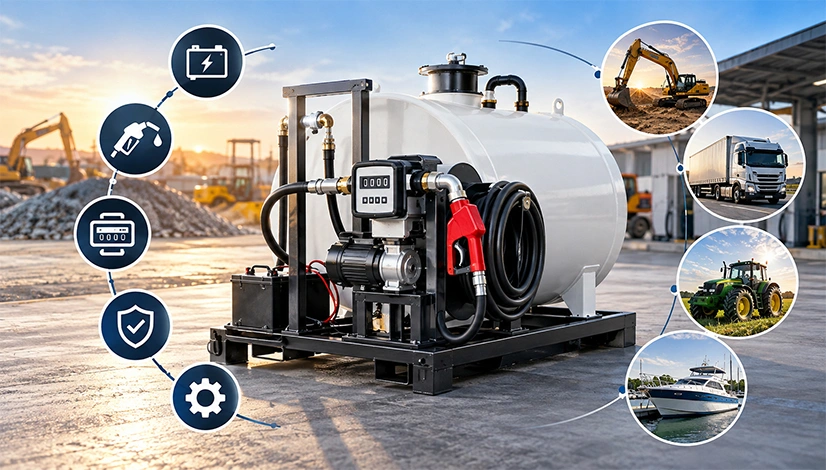
For scattered generator refuelling, smaller service vehicles and moderate-volume routes, DC can provide a practical balance of mobility and control. For mining, construction, large fleets or dedicated fuel trucks with higher peak demand, PTO can be appropriate when the vehicle is designed for it. The best 12V DC vs PTO Fuel Dispenser selection matches power architecture, throughput and installation—not just headline LPM.

How Eastman Meters Fits the Selection Process
Eastman publishes dedicated pages for both models, which makes model-specific comparison possible. For a 12V DC vs PTO Fuel Dispenser enquiry, share vehicle type, tank capacity, litres per day, peak litres per hour, hose reach and whether preset or printed transactions are required.
12V DC Digital Mobile Fuel Dispenser | PTO Operated Mobile Fuel Dispenser
Frequently Asked Questions
Not across every product. For the two Eastman models covered here, the listed ranges are 1-40 LPM for EMDU-BT-20 and 1-80 LPM for EMDU-PTO-25. Actual output still depends on the complete installation.
Eastman describes its digital DC unit as suitable for compact mobile mounting with an IBC or small demountable tank, subject to a suitable engineered installation.
Yes. PTO operation depends on a suitable vehicle power take-off arrangement and should be checked with the truck manufacturer or a qualified installer.
Neither power source is automatically better. The compared Eastman digital models both list preset functions and micro-printers. Select the controller and reporting functions your operation needs.
Conclusion: Choose the System Around the Job
There is no universal winner in a 12V DC vs PTO Fuel Dispenser decision. The DC model offers compact electrical pumping with a published 1-40 LPM range; the PTO model uses truck-engine power and is listed at 1-80 LPM. Both can support controlled digital dispensing when correctly selected and installed.
Define peak throughput, vehicle platform, hose reach, transaction needs and installation constraints first. Then verify the exact model specifications and approval documents supplied for the project. That approach makes the 12V DC vs PTO Fuel Dispenser choice measurable, current and defensible.